👍👎 Rating matches
THUMBS UP CONFIRMS A GOOD FIT, THUMBS DOWN TRAINS THE MATCHER TO STOP SHOWING THE WRONG THING. RATING IS THE BIGGEST LEVER YOU HAVE OVER RECOMMENDATION QUALITY.
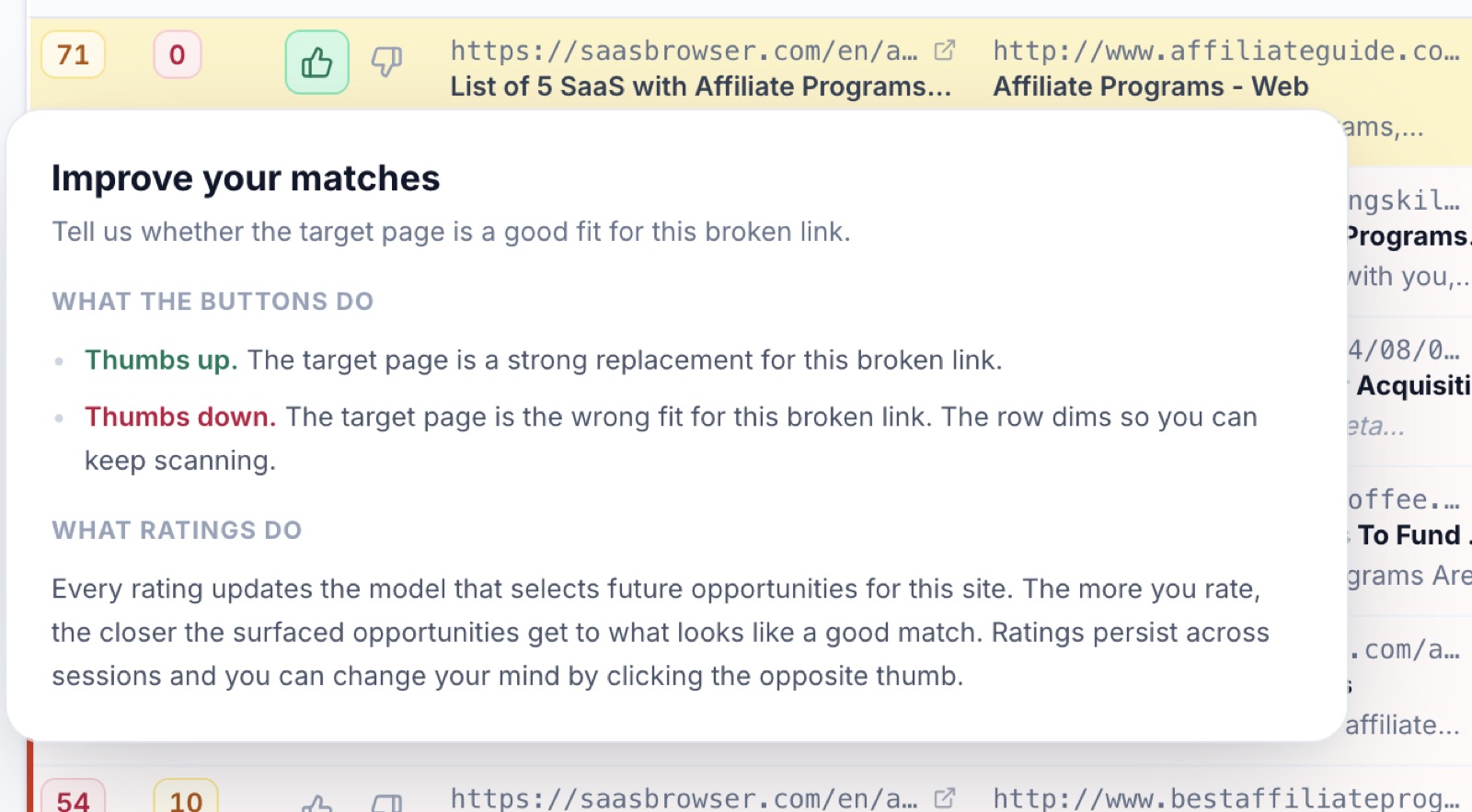
Rating is not optional polish. It is the mechanism that turns generic recommendations into ones tuned to your taste. If you want better opportunities, this is the page that does it.
Why ratings matter so much ⭐
The matcher (see The Opportunities table) finds candidates by topic and scores them for fit, but it can’t read your mind. Two SEOs in the same niche have different definitions of “a fit”: one welcomes broad citations, another wants pages that match the dead link almost exactly. Two teams looking at the same row will sometimes disagree on whether the source domain is even worth pitching to. Without your input, the matcher has to make a generic guess.
Every time you click 👍 or 👎, you teach the matcher what good looks like for you. Thumbs-up tells it: more rows like this one. Thumbs-down (especially when paired with a reason: see Telling us why something isn’t a fit) tells it: fewer rows like this one. Those signals improve the recommendations you see going forward. The more your team rates, the more the shortlist starts to look like the picks you would have made manually anyway.
In other words: rating is how you teach the system what good looks like for you. No ratings, no learning. Lots of ratings, real lift.
What the buttons do 🖱️
Every row in the Opportunities table has two thumb buttons in the Review column.
- 👍 Thumbs up 👉 this is a strong replacement for that broken link. Use it when you’d actually be happy to see this in your shortlist.
- 👎 Thumbs down 👉 this is the wrong fit. Use it when you’d skip this row in real life. Pick a reason from the popup so the system knows why.
Ratings persist across sessions, and you can change your mind by clicking the opposite thumb at any time. There’s no penalty for re-rating. If your strategy shifts (you decide to chase higher-authority sources only, or to stop pitching to a particular niche), go back and re-rate older rows; the new ratings override the old ones.
What changes after you rate 🔁
Two things, on different timescales.
- Immediately, in the table. Filtering and sorting respect your ratings right away. You can filter to “Up” to see only your confirmed picks, “Down” to audit your rejections, or “Unrated” to keep working through the queue. Download Confirmed (see Exporting opportunities) only includes thumbs-up rows.
- Over time, in the recommendations. Every rated row sharpens the matcher’s sense of what fits your site. As your rated history grows, future opportunities start to skew toward the kinds of matches you keep approving and away from the kinds you keep rejecting. You won’t see that as a one-click before/after. You’ll see it as a quietly tightening shortlist over the weeks following heavy rating sessions.
That second loop is why rating early and rating often pays back compounding interest. The first 50 ratings on a fresh site already shape what gets surfaced; the next 500 reshape it more.
Rate in batches, not perfectly ⚡
You don’t need to rate every row. You don’t need to be 100% confident on every click. The matcher handles noise; what it can’t handle is silence. A team that rates 200 rows in 20 minutes (even with a few honest mis-clicks) is teaching the system orders of magnitude more than a team that rates 5 rows perfectly.
A good rhythm:
- Open Opportunities sorted by Score descending.
- Filter to Rating = Unrated.
- Walk down the list. Hit 👍 on rows you’d be happy with, 👎 (with a reason) on rows you wouldn’t.
- Stop when your eyes get tired. Come back tomorrow.
Tips 💡
- 🧪 Aim for at least 20-50 rated rows on a fresh site before evaluating recommendation quality. Fewer than that is noise.
- 🎯 Use the Rating = Down filter occasionally to audit past rejections. If a thumbs-down was wrong, flip it; the new rating corrects the older signal.
- 🤝 Share the workload across your team. Every rater’s input counts. Different people will catch different kinds of bad fits.
- 🪫 Rating one row is better than rating zero rows. Don’t wait until you have an hour. Five minutes of rating still moves the needle.
- 📝 When you 👎, picking a reason matters. A blank thumbs-down is a weaker signal than “Source competes with me” or “Quality issues with the site or page”.